Bridgewater Drought Status
Level 1 – Mild Drought (Last updated: 1/12/2026 )
Conditions indicate below-normal precipitation. Residents and businesses are encouraged to practice water conservation and follow any local guidance.
What this means in Bridgewater
- Water supplies are below normal due to prolonged drought.
- Indoor water conservation is strongly encouraged.
- Residents and businesses must comply with all local water-use restrictions.
- Private wells and non-MWRA water sources may be especially impacted.
How residents and businesses can help
- Minimize overall water use, especially indoors.
- Fix indoor leaks such as toilets, faucets, and showers (over 60% of indoor use).
- Follow all local water use restrictions.
- Large buildings and businesses should conduct water audits to identify leaks and conservation opportunities.
Quick Links
Statewide Drought Update (January 12, 2026)
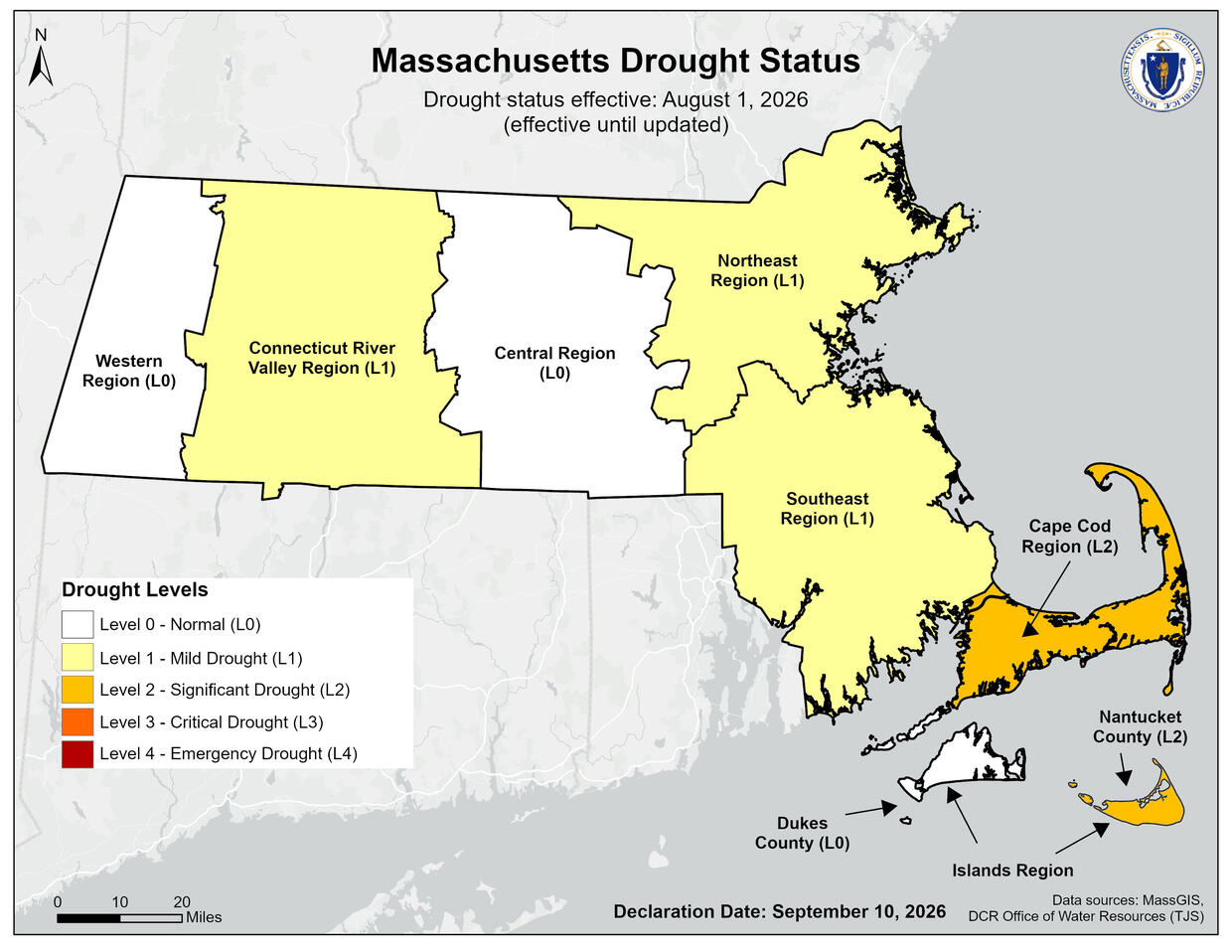
On January 12, 2026, the Massachusetts Executive Office of Energy and Environmental Affairs (EEA) issued an updated drought status. EEA Secretary Rebecca Tepper announced that drought conditions worsened in the Central and Northeast Regions to a Level 2 – Significant Drought. Conditions also declined in nearly all other regions, moving the Southeast Region to a Level 1 – Mild Drought. The Millers River Basin worsened to a Level 3 – Critical Drought.
- Central Region: Level 2 – Significant Drought
- Northeast Region: Level 2 – Significant Drought
- Southeast Region: Level 1 – Mild Drought
- Millers River Basin: Level 3 – Critical Drought
- Islands Region: Dukes County returned to Normal Conditions; Nantucket County moved to Level 3 – Critical Drought
- Unchanged: Western Region, Connecticut River Valley Region, and Cape Cod Region
In December, Massachusetts received 3–4 inches of rainfall, but the total still finished 1–2 inches below normal. Looking back over the past 3–6 months, precipitation deficits persist, though the forecast anticipates near-normal precipitation through the end of the month.
The drought, which began in 2024, has continued to impact the natural environment across Massachusetts, including the drying of streams in nearly all regions, lower water levels in lakes and ponds, and impacts to fish passage out to the ocean.
As outlined in the Massachusetts Drought Management Plan, continued detailed monitoring of drought conditions is required, along with coordination among state and federal agencies to implement drought response actions. Municipal engagement, including local Boards of Health (BOH), remains essential. Residents are asked to report well issues (including wells drying up) to their local BOH; BOHs are asked to report on the condition of local private wells.
Residents can report dry environmental conditions and submit photos through the Massachusetts Water Impact Reporter. A FAQ is also available for questions about the current drought status and water conservation, and private well owners can find information on how drought may affect them.
The Massachusetts Department of Environmental Protection (MassDEP) will continue assisting communities in managing their water systems. The Massachusetts Water Resources Authority (MWRA) water supply system is not experiencing drought conditions.
State agencies will continue monitoring conditions and coordinating public information. The Drought Management Task Force will meet again on February 10 at 9:30 AM. Residents and businesses are urged to check with their local water system to see if more stringent local watering restrictions are in place, including for those using a private well.
Why Conservation Still Matters
While the MWRA water supply system is not currently experiencing drought conditions, private wells and local water sources are impacted. All water sources ultimately draw from the same river basin.
“Even with winter weather, several regions in our state are facing below-average precipitation. To avoid overtaxing our water systems, we must prioritize indoor water conservation.”
— EEA Secretary Rebecca Tepper
Contact the Water Supply / Water Pollution Control Office at 508-697-0910.